

-300x300.jpg&w=48&q=75) Author: Veress Árpád · Explosion-protection expert
Author: Veress Árpád · Explosion-protection expertRestart Is a Decision Point, Not an Administrative Step
The fourth and final part of the Operations BowTie moves to the right side. Immediate mitigation, detect, restrict, escalate, make safe, stop, respond, keeps a loss of control from becoming an explosion. But the article argues the sharpest point of intervention comes later, at restart. "Maintenance is finished, can we restart?" is the moment where production pressure meets an unverified Ex condition. Work complete is not the same as Ex-safe condition demonstrated. The piece closes by assembling all four parts into one coherent BowTie and one clear definition of the role: Operations owns the decision points.
Follow up on BOWTIE with Head of Operations - next topic is mitigating barriers.
Before the Top Event, the question is: “How do we prevent losing control?”
After the Top Event, it becomes: “How do we prevent loss of control from becoming an explosion, injury, damage—or an unsafe restart?”
The POI is therefore the trigger at which Operations must activate, escalate, or verify a mitigating barrier.
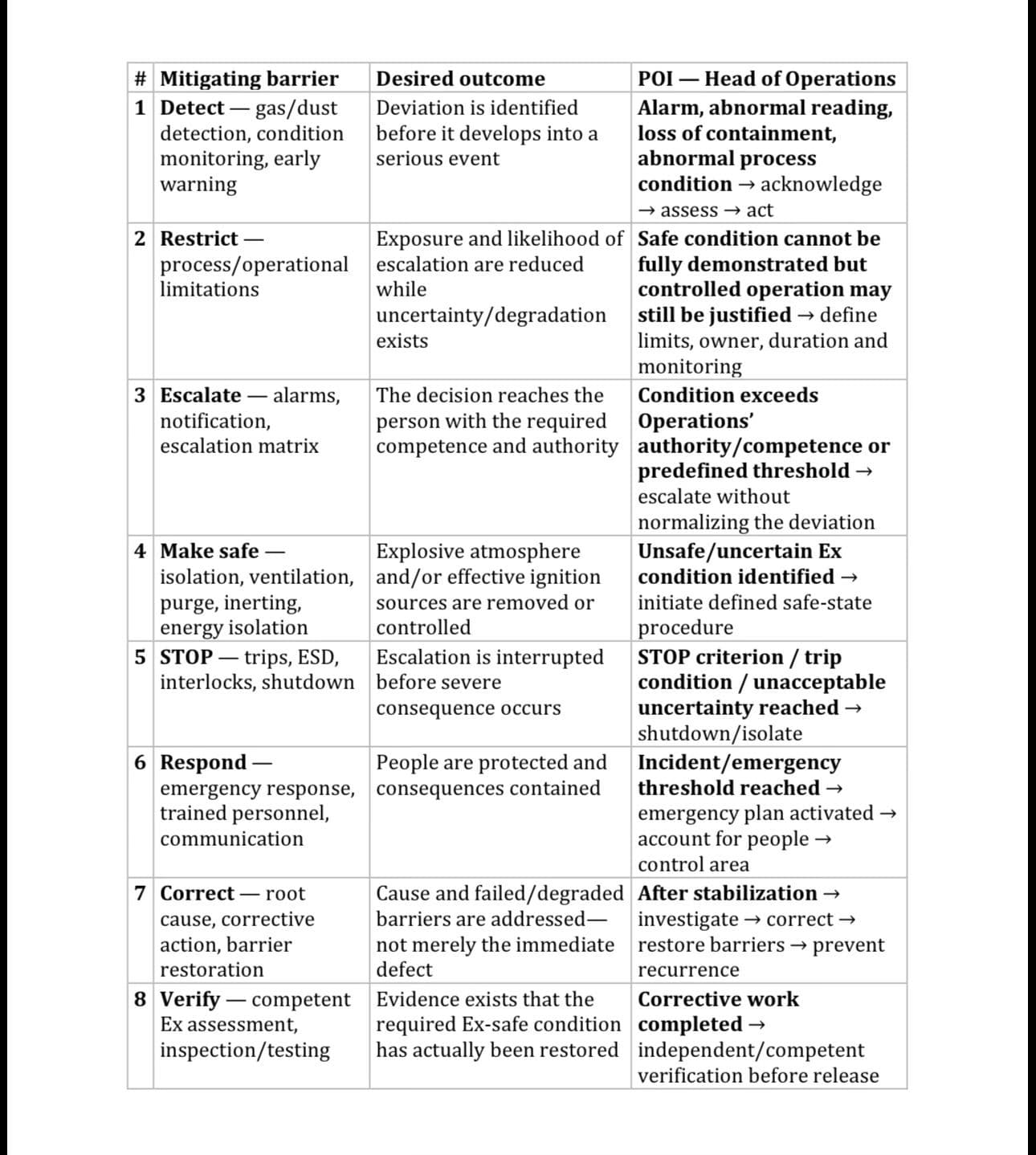
There are really three phases:
Immediate mitigation
Detect → Restrict → Escalate → Make Safe → STOP → Respond
These prevent the Top Event from developing into the worst consequences.
Then comes recovery and assurance:
Correct → Verify → Return to Service
These don’t necessarily mitigate the physical consequence of the original event. They prevent something equally important operationally:
returning the plant to operation without having re-established the demonstrated Ex-safe condition.
The critical POI may actually be restart
Imagine an Ex deviation occurs. Operations stops the equipment. Maintenance replaces something. Everyone wants production back.
The dangerous sentence is:
“Maintenance is finished. Can we restart?”
That is a major Point of Intervention for the Head of Operations.
The sequence should be:
Work complete ≠ Ex-safe condition demonstrated
Instead:
Correct → inspect/test → Ex verification → documentation → residual findings reviewed → authorization → RETURN TO SERVICE
And the possible operational outcomes should remain:
CONTINUE — conditions demonstrated.
RESTRICT — controlled operation within defined limitations.
MAKE SAFE — stabilize the situation.
STOP / ISOLATE — unacceptable condition.
ESCALATE — decision requires additional competence/authority.
RETURN TO SERVICE — only after verification.
Putting all four parts together
We now have a very coherent Head of Operations BowTie:
THREATS
What can take us outside the demonstrated Ex-safe condition?
→ POI: recognize the developing threat
PREVENTIVE BARRIERS
What keeps us inside that condition?
→ POI: verify barrier effectiveness
DEGRADATION ELEMENTS
What is weakening those barriers?
→ POI: recognize degradation and intervene
TOP EVENT
Plant operated outside its demonstrated/documented Ex-safe condition
MITIGATING BARRIERS
How do we prevent this condition escalating and regain control?
→ POI: detect / restrict / escalate / make safe / STOP
RECOVERY & RETURN TO SERVICE
How do we demonstrate that Ex-safe operation has actually been restored?
→ POI: restart authorization
This gives a very strong definition of the Head of Operations’ role:
Operations does not need to personally perform every Ex activity.
But Head of Operations owns the decision points: when to continue, when to restrict, when to escalate, when to stop—and when the plant may return to service.